Showing posts with label Sociological Imagination. Show all posts

Saturday, November 30, 2024

Nov. 30 (Sa,) 2024 Seat Belt!


Brian S
Why am I not surprised? I will add that EM is a vampire that preys on gifted and talented individuals. He isn't nearly as great as he and his followers think he is.

Zena Huang
Dear Brian, ya, there is a story (伯樂相馬) about a man who knows how to choose special horses to work for him. This type of ability makes him rich and famous. Man vs. horse, which one has higher possibility to get what one wants?

Brian S
Man will always win over the horses sadly. The only recourse is for the horse to break out of the barn and escape!

Zena Huang
Agree. And we also need more horses like Mr. Ed. !

Wednesday, March 20, 2024

March 20 (W), 2024 The Sociological Minds-Eyes


A couple of Youtube channels with independent thoughts (or book/film selections) from Taiwan caught my attention. Taiwan's economic-political system tends to be seen as a type of state capitalism or quasi- capitalistic entity, with some similarities with Hong-Kong-before-1997, Japan, Singapore, and S. Korea, all under an umbrella of a bigger, "advanced" capitalistic camp.
 
These Youtube channels that I found stood out with wider politico-economic ideologies. They have something relating to Sociology, Philosophy, and History. Here is one of them. (I selected a couple of videos form the following channel - https://www.youtube.com/@superycinema).

A reflection after having watched the videos:

Watching videos from this channel always reminds me of a small episode when I taught sociology at a Midwest technical college a while ago.

This was about a female student attending my sociology class. After a couple of weeks' classroom sessions, she told me that some friends alerted her that sociology was not a good idea to be a selective course (note, most Gen Ed courses were not required for their degree programs. So, they were open as selective courses for credits) before her registration. That's why she had hesitated for a while to take this class. I asked her to tell me more about what "not a good idea" meant. She told me that so far she felt sociology quite interesting, not like what she was told that sociology taught people "against the society's values...," and advised her to take psychology, instead. But she was glad that she took sociology.

Then I asked if she could give me some examples about "against society's values". She frankly pointed out that they told her things like GLBTQA rights/atheists, diversity issues,  some taken for granted traditional values, pitying "underdogs," and a few religious denominations' practices...etc. that were not what they believed for.  She added that she was a pious Christian.

I could fully understand where she was from. But, this short story happened a long time ago. Now, things could be changed.

Among the 4 major sociological perspectives: Structural-functional, Symbolic, Conflict, and Feminist analytical approaches, from my observation, most students had hard time, or preferred not to "recognize" the conflict perspective to analyze social issues/problems. Same as within the Structural-Functional's manifest, latent, and dysfunction sub-perspectives, the latter two, tended to be challenging to be applied in analyzing social events for most students. It is easier to see issues or problems from the individual level. To link with institutional or societal/bigger cultural level, even, global level, required more efforts. As C. Wright Mills (1959) describing an awareness of the relationship between a person's behavior and experience and the wider culture shaping the person's choices and perceptions, such a sociological imagination takes great endeavors to cultivate.

Well, one more episode just popped into my mind. This one was from my hind-sight perspective, hopefully, not tinted with too much sociological imagination. It was during the fall semester of 2015 to 2016 (ya, the heated election season with a very "special" school administration under a very conservative governor,) suddenly several sessions of sociology were cut down, replaced by psychology which I taught too, but I preferred to teach sociology. One more interesting phenomenon was that more students with military background registered my Art Appreciation and Sociology sessions in 2016 than before. Yes, in the past, many semesters I had a few students with such backgrounds attending my courses. From my understanding, they knew I served in the military before. Such an experience turned into a point of preference for them to select my sessions. (The course had multiple sessions taught by several other instructors as well).  But, in this semester (the hot campaign season,) the dean told me that two students reported that I said something regarding political in/correctness that s/he did not agree with!!! (Well, this was not a math, chemistry, or computer science class, was it?)

Indeed, just being a messenger of sociology was not an easy task!! Trying not to be over sensitive about identity: being the only, non-native English-speaking non-Caucasian instructor in the college, always in high alert, not to step on the sensitive red-line (for 18 years), consumed much more nervous energy than that of teaching per se. Perhaps, between teaching natural sciences and social sciences, the teaching philosophy and pedagogy exists some differences, particularly, at the technical college level?

Now, switching gear toward myself - thinking of teaching sociology…this event also reminds me of a popular neologism of the conservatives – Baizuo (白左, literally, white left), a derogatory term used to refer to Western liberals and their values, especially in relation to people who concern social issues, such as immigration, marginalized groups (GLBTQA rights, multicultural diversity, welfare state), widening class inequality, digital divide, animal rights, environmental activism and so on, ideas of critical theories- in particular,  egalitarianism, and humanitarianism.

The term Baizuo originated in the 2010s, attributed to several surveys through overseas Chinese, most of them, in the US., who left their motherland for varieties of reasons. Most of them disliked the CCP regime’s ideology and practices. The surveyed communities tended to be residents of the middle or higher social classes of high-tech practitioners or small businesspersons. As a result of their specific lifestyle, short of understanding, experience/education, or ingrained with their traditional, ideological constraints in humanitarian equality, and their hard-working, marginal journey in the West, most of them are "uncomfortable and even hostile" (Cheng, 2019, p.184) to new concepts in racial/class/gender equity, sexuality, family, religion and the rest of diversity issues. This conservative phenomenon is quite similar to some small capitalistic bourgeois mentality or residents of the rural areas in the US.

Cheng’s research also reminds me of one recent event about a successful reporter of the CCP-regime. Due to some reasons, he/王某人 offended his government, later escaping to Japan, working as a youtuber. He got a visitor visa to travel to Taiwan and observed the key elections in the early January of 2024. Amid the trip, in a Taiwan night-time talk show, he mockingly mimicked a physically challenged candidate whom he saw during a political campaign activity - to please the audience of that night. Such a behavior aroused the anger of Taiwanese people who asked him to apologize to Mr. Chen, a lawyer running for a congressional position, and all the disabled people in Taiwan. But he felt people in Taiwan just making a fuss, unwilling to make such an apology. Then, he framed the whole issue was a plot done by a political party in Taiwan that he disliked. Furthermore, he stirred up his hardcore fans’ sentiments through his video site to attack Taiwan Government, like the popular tactics of pitting people against people approach employed by Mao in early 60s, and still practiced now – the Maple Bridge Experience (楓橋經驗). He, indeed, is one-of-a kind of the popular media high-achiever! Corresponding to his mindset, as we know, there is a super famous talk show star in the CCP, who made fun of disabled people as part of his performing motif!!! Having taught Diversity Studies for many years, I could understand where they come from. Another explanation may be that there exists a wide "cultural lag" between CCP-China and Taiwan... ( I wrote a critique on this issue posted on Jan. 25, 2024: https://ci8395.blogspot.com/2024/01/jan-25-th-2024-are-some-bad-apples.html, for reference).

Tracing back even further, the term, Baizuo, used by those who were anti-CCP style of communism, probably also, initially aiming at mocking American and Western communists who traveled to China to support the communist revolution.  Later, the widespread of the Baizuo concept was reinforced by the Western liberal ideologies and some European governments, particularly A. Merkel’s administration, for their alleged over-tolerance during the refugee crisis, and the rise of popularity of D. Trump's populist policies (Cheng, 2019). Since then, the term has begun to be widely used in English, particularly around the American conservatives, notably, the Chinese anti-communism and pro-democracy activists in the US., who use the term to refer to others who don’t hold the similar ideology as they do.

Just found some interesting studies relevant to the topic. I excerpted a part of it attached below:

"D. Trump announced his candidacy for the U.S. presidency in 2015. His right-wing electoral strategy has appealed not only to Chinese nationalists but also to many Chinese liberals". (Lin, 2021). "For nationalists, Trump's populist, anti-immigrant campaign has appealed to them, though that appeal is also noted as more of an opposition to American liberalism or even liberal democracy itself".  (Zhang, 2020; Lin, 2021). "Over time, the term has come to be used to describe people who uphold similar policies, such as B. Obama, rather than focusing on their race". (Chen, 2022). "For Chinese liberals, or at least some of them, Trump's toughness and conservatism toward CCP-China have appealed to them, and they want to use similar conservative ideas to promote a liberal democratic system in China. Both liberals who support Trump and those who criticize him invoke cases like the Cultural Revolution/文化大革命 or the Great Leap Forward/大躍進 as an overall critique of leftists and believe that the American left will similarly lead to these happening in the United States. The former equate the removal of Confederate memorials with the destruction of the Four Olds/破四舊, Black Lives Matter activists with the Red Guards/紅衛兵造反, and MeToo with the big character poster/遊街示眾貼大字報 or struggle session/楓橋鬥爭活動. They draw the conclusion that the 'white left' is wreaking devastation on America through these analogies. The latter, though, connect Trump's populism to Maoism". (Hendriks-Kim, 2023; Gao, 2023)

An interesting phenomenon is that these groups of people, even holding the US. green card or naturalized as the US. citizens, seem blind to an individual who has been entangling with hundreds of civil and criminal cases, inciting a mini-coup against his own country, disturbing social order for many years, attempting to turn this nation into a banana republic and the rest of anti-democratic activities.  And then, these groups of "seeking-freedom-democracy-and-protection" immigrants, regard him as a persecuted victim by his government. No matter what, as long as this person with his populist proteges, dares to yell at the CCP-leader and the regime, then, he, to be the leader of the US, and a proxy avenger for them, seemingly can serve the best interest of their once-damaged mindset done by the CCP regime? But what about other purposes to choose/adopt and stay in this country?

Zhang in another paper (2019) summarized the commonality of hundreds of relevant responses to his research: "they accused Baizuo of being hypocritical humanitarians who advocate for peace and equality only to 'satisfy their own feeling of moral superiority'; of caring only about topics such as immigration, minorities, and LGBT rights; of tolerating the 'regressive values' of Islam for the sake of multiculturalism; of supporting the welfare state at the expense of tolerating lazy people; and of being 'ignorant and arrogant westerners' who 'pity the rest of the world and think they are saviors' ".

Well-known to the world, the CCP-regime hoisting the giant banner of fighting for social justice, horrifically persecuted and purged many so called Five-Black-Categories, deemed as historically over-privileged classes and advantaged individuals, or anti-communist-equality reactionaries. How can the victims or survivors of these groups forget such nightmares? A “gestalt communism” based on those cruel treatments may shape their views toward other types of socialism or communism that grow out of nourishing cultural-backgrounds, such as the political parties/organizations in the Scandinavian countries, France, Germany, Italy, Japan, UK, the US., and the rest of more than 90 countries in the world. Thus, doesn’t the over-generalization-analogies seem tinted with oversimplified stereotype mixed with their specific super-inferior complex, ultra-nationalism, and some sort of the Dunning–Kruger syndrome? (The so-called: 身在曹營心在漢, 在美受生活, 反/害/厭美是工作).

Furthermore, with such a different humanistic progressing gap exists in the wide spectrum of human development amid many cultures and countries, lots of individuals, groups/organizations, and nations engage in different types of humanitarian endeavors can be easily labelled by the do-good-doubters as “SJW” (social justice warriors), a derogatory term referring them as the commonly known - Gauche caviar, Boba liberals, champagne socialists, cultural Marxism conspiracy theorists, the pushers of declining of the West, liberal elites, limousine liberals, just to name a few. One good example is an interesting yet horrific film – “Green Inferno,” depicting such a controversial sentiment to the bone.

Perhaps, being through thousand years of feudal-monarchical vicissitudes, suddenly, a brand-new ideological product of the western industrialization thrusting into an old empire may not bode well. Then, what happened was under such as a speedy change, without time to digest, a toddler was on the pilot seat, flying an airplane, carrying 1.3 billion of obedient passengers over the world…  

Whether mushrooming from an infertile/inhumane breeding ground or developing from the long tradition of humanistic historical context, generates quite different modes of socialist and communist ideologies and practices in human societies. The CCP-Style of hybrid (fake) communism, has not much to do with the original Marx and Engels’ thoughts except an over-growing apparatus of the autocratic police state.

The establishment of the CCP regime creates a false if not misunderstood experience of socialism/communism to its people. Such an authoritarian-ideological framework is ingrained in many of its well-surveilled citizens, even in the intellectual circles, whether inside the regime or probably, more in overseas.

Here is a previous post relevant to this topic too. 
Title: Reasons against a fake-communism?


The rest posts are videos of the aforementioned channel:
 

Saturday, February 11, 2023

Feb. 11 (Sa), 23 Developing a new series - Sociology of the Feline. Cover page and Episode One


---------------------------------------

This is a copy of the previous semester Syllabus of Applied Felineology - for reference:
----------------
Attention! Due to the Pandemic, the preferred face-to-face class has to be compromised into the online format.

Course Title- Applied Felineology!

Credits- 3. 48 hours (based on WI state requirements).

Competencies - Upon completing this course, you will fully understand how to be proudly admired , adored, and most importantly, worshipped.

Instructor - Felineology professor Dr. Catcrystal Huang.

Location- Online, But, if the blue sky classroom, or on the refrigerator, inside the box/drawer, under the bed, on the window sill, and the rest of catclandestine places (f2f or blended) are requested, you guys all need to wear masks properly with 2 doses vaccinated, 6-foot distancing, drinking a lot of water, and keep a strong immune system.

Office hours: Any time beyond your catnaps or by the appointment when you are awake or feel bored.

Textbook: Co-authored by Dr. Catcrystal Huang and the previous feline Ph.Ds. "From Ancient Egypt to the Post-Modern Felines in Transforming the Homo Sapiens Species". 2nd ed. Publisher: LCH and Felines Inc.

Tech needs- Please read carefully. The following statement was revised. " Any artificial-repressive-forced tech-device consumption stifling Feline scratching Desire, Imagination, and Creativity will be eliminated."

Instead, please check the following tools. Let me know which one you prefer: Loom, Snagit, Soapbox, Camtasia, VEED, and Vidyard.
We will vote on coming Monday.

Class size: This year, 4 Ph.D. feline majestic students were Recruited from the local Humane Society as our 3rd cohort experiment.

Delivery format: So, the online will replace the previous face-to-face, one-on-one authentic felineological education.

Tuition/installments- To cover the course materials, the tuition is depending on catindividual's financial catpacity (恣備束貅). No feline student debts shall happen, and surely is not allowed! Why, because your instructor has been struggling to pay a total amount of $60,000 tuition bills over 8 years for a terminal degree (technically, 2, technology edu, and art edu). Thou, shall not suffer what your instructor has been through!

Payment Method- Any type of tuition installments will do EXCEPT mice, baby rabbits, birdies, moles, golfers, and the rest.

Grading system –
A, Rewarded with Feline fancy toys;
A+ Super-catnip;
A++ Home-made treats;
A+++ Luxury cat sauna/massage.

Classroom procedures- Only 2 classroom management mandates:
1. Everyone complies - Thou: shall not Kill... =^.^= !
2. Respect and protect the Feline 1st Amendment and the Feline Constitutional rights - everyone should meow, regardless of how loud it is, how different the catidiology is, or the Feline-Party affiliation is. You have the right not to meow back or engage in cat-fights as well as unnecessary seductive catwalks.

Your fur Colors, definitely make our classroom flamboyant. All Feline meowing Accents are welcome ( your instructor, Catcrystal actually, is bilingual - English and Meowglish. She meows with a very cute accent inherited from her Taiwanese mother tongue since she came to the US. at the age of 35 ! In fact, she prefers meowing to speaking in English!

Whether you were abandoned, abused, disabled, with different feline sexual orientations, out of wedlock, or from a broken family, you will not be judged by your socio-economic background. Your Life Chances to reach your feline potential are equally enhanced.

Seriously keep in mind - your feline student rights:
We hold these truths to be self-evident, that all felines are created equal, that you are endowed by the Almighty Powers with the most unalienable Rights, that among these are Feline 9 Lives, Feline Liberty and the pursuit of Feline Happiness of being deeply admired, adored and worshiped.

Good luck!

Have a supreme Categorical semester - meooooooow !

----------------------------------------

LC Huang
A previous video with relevant info made for non-feline learners:


https://www.youtube.com/watch?v=4jDGqwubZlk

Sunday, March 7, 2021

March 7 (Sn), 2021 Natural Catastrophes vs. Man-made Disasters Part 5


Citizen journalism #198. Pop-quiz on the recent chaos and tragedies happening in the domestic and global spheres:


Zena LC Huang
Found one of my Sociology old lecture notes on Government and Politics:


Zena LC Huang
The Telegraph News: Between the Sino-US competition, France, an alternative Power on the world stage.
https://www.yahoo.com/.../france-sends-navy-mission-south...


NEWS.YAHOO.COM
France sends navy mission to South China Sea as tensions build in Beijing's back yardFrance sends navy mission to South China Sea as tensions build in Beijing's back yard

Monday, June 1, 2020

June 1 (M), 2020 Where is home? What is home?


One more post for today:


 Just converted some of my classroom lecture notes ( a couple of chapters in Sociology) into a video. https://youtu.be/63tGClZ--RI

<iframe width="460" height="270" src="https://www.youtube.com/embed/63tGClZ--RI" frameborder="0" allow="accelerometer; autoplay; encrypted-media; gyroscope; picture-in-picture" allowfullscreen></iframe>

Saturday, August 10, 2019

Aug. 10 (Sa) 2019 Wanna to open up more than 20 dormant mind-eyes ?


艋舺臺灣

...../\„,„/\.........//^ ^\\ Live without hurting the Earth (and all the sentient beings)
...( =';'= )......(/(_•_)\) Talk without cellphone
..../" * * "\...._/'' * ''\_ Care without lacking actions
....(,,,).(,,,)....(,,,)^(,,,) and smile without selfies.

Have a nice weekend. 願您 慈悲為薪, 智慧如火. 8/10/19 (Sa)


艋舺臺灣 This home-groaned recipe (This home-groaned recipe (inspired by C. Wright Mills) is part of my week 1 Sociology course materials. It shall not belong to the classroom only.
Do it! To practice, is to believe.


艋舺臺灣 Bertrand Russell feels the same way ...


Tuesday, July 9, 2019

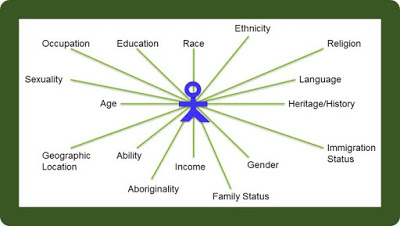
July 9 (T), 2019 The main and interaction effects in the Matrix of Domination/Complex Inequality of Intersectionality !!!


Self, Status, and Intersectionality


IP or Identity Politics like PC, Political Correctness, is a familiar, yet unclear and controversial sound bite in the recent political theater. Among these IPs, “intersectionality” out-stands as almost as a complicated cliché, which found its contemporary alternative perspective of social reproduction theory (SRT).  The concept of social reproduction was originated from Karl Marx in Das Kapital. It is a variety of his broader idea of reproduction under capitalism of his time. According to sociologist C. B. Doob, it "refers to the emphasis on the structures and activities that transmit social inequality from one generation to the next".  The designed/structured race, gender, class, and the rest of man-made inequality under capitalism interplay into a totality of human exploitation and oppression in the contemporary neo-capitalism. In the following writing focuses on intersectionality. For SRT, will be available in the near future.  Stay tuned.

Intersectionality is an academic jargon, used by many people in different fields. This writing intends to provide some relevant information about it and its deep roots.

So, what is Intersectionality?  It can be traced back to 1980s. An anthology was titled “All the Women Are White, All the Blacks Are Men, but Some of Us Are Brave,” addressing the issue that black women were both invisible as women in the women’s movement and invisible as blacks in the civil rights movement. From the intersectional perspective, black women were marginalized or invisible within both movements, even though they were doubly discriminated (The Meaning of Difference, 2016, p.215) .  Later, in the early 1990s, Law scholar Kimberle Crenshaw explained African women’s experience in the US. through the lens of interaction of gender AND race, not a discrete experience of race OR gender (class can be added too).  Such a multiplied effect of several statuses or identities is called the “Matrix of Domination” or “Complex Inequality.” 

The analysis of intersectionality is like ANOVA[1] and factor analysis[2] in statistics to exam “main effect” and often time, “interaction effect” of variables. For example, a research studies how race AND gender affect income, or educational level, age, AND marital status affect promotion and income. In these situations, certain variables through mutual interactions create detectable effects and are given priority for calculation. Similarly, in examining man-made intersectional inequality, some conditions have priority over other traits or forms.

Intersection


    Totality of Intersection: Complex Inequality

To understand intersectionality in human diversity, one needs to delve into the basic, analytic units (building blocks of social structures) in sociology – role, status, the concept of self. In philosophy, psychology, and spirituality, the concept of self was developed and interpreted according to the disciplinary approaches.[3] In this writing, I only focus on sociological perspective.    

As mentioned in a previous blog of mine regarding cultural capital (https://ci8395.blogspot.com/2019/06/june-15-sa-2019-classic-video-is.html), social status has three major categories: ascribed, achieved and master. Each given/involuntary, earned/voluntary status has multiple roles to act out a specific status. People carry multiple status sets, of which the multiple roles (role sets) to act out the specific status set accordingly. Thus, status functions like scripts of dramas, while role acting out the scripts. Sociologist Peter Burger referred it as puppets and puppeteers acting in front of and back of the human stage. By being aware of the whole world being a stage, the awakening dynamics can cut off the Invisible String to gain freedom.


Regarding multiple statuses and roles that one carries, the master status tends to be the conspicuous one that overshadows the rest.   The connection between role and status, also relies on socialization process.  George Herbert Mead (1863-1931) developed the concept “social self” through “generalized others” as an important step that children form their concept of self through playing, and interacting with others (particularly, the significant ones.)  Mead proclaims that the self is a part of an individuals’ personality comprised of self-awareness and self-image that are the product of social experience. By taking the role of others, the interaction of the two parts of self: I and Me, develop. People gradually form self-image and shape self-aware, as Cooley’s looking glass self indicates.

Among the four major socialization agents, family is the most important one. Parents give various identities to children. Among them, race and gender are the most essential two. Social class though tends to be invisible or unaware of, playing a major part in shaping children's personality.  Different cultural capital, positive and/or negative,  is passed through family dynamics to offspring.  No matter what social class children are born into, in the long run, they learn how others see them and in terms, they could see their own class, intersecting with other ascribed statues to form self-identities.
  
To explain the complexity of intersectionality in the classroom, I use the following example to identify the multiple layers of intersections within a person as the first step to decode this term: “Here is a female, "non-White" person with mental illness, who is a lesbian and homeless.” Surely, students can identify race, gender, sexuality, class, and invisible disability based on the above description. But in the real life situation, class, sexuality, and mental condition tend to be hidden, or invisibly discreditable, which can be passed into, or perceived as “normal.” Furthermore, the severity of each dimension of inequality and multiply interfaced dimensions of class, race, gender, sexuality, disability, religion, language, nationality...etc. comprised a complex package of identities which are incomprehensible to most of the dominant group.  Generally speaking, color is the most obvious signifier among all, and gender follows (WYSIWYG, what you see is what you get.) Most of us understand how color ties to the disturbing history and is still lingering to today’s big words of instinctive or implicit biases.

For convenience, using the above case, if one wants to understand why an individual ends up being homeless, there could exist multiple factors related to it.  If race had been identified as the “main effect” in the study, what about the "interaction effect" among the rest of relations within variables, and to the main effect?  For example, how gender, class and disability interact with race, creating a new impact on the conditions of homelessness? Furthermore, which type of interaction carries more obstacles for being homelessness?  In most situations, due to the WYSIWYG effect, one's master status supersedes the rest of hidden or invisible identities. Thus, the complexity of privileges or stigmas turn into the main sources of explicit and implicit advantages, biases, benefits, stereotype, prejudice, entitlements, and aversive/discrimination that people are not aware of, or intend to ignore/deny their existence. For example, a common "natural law language" (will be addressed in the next writing) goes this way, "Poor people are lazy." Most people immediately visualize (explicitly) with emotion (implicit) about what poor people look like, which easily dismisses other severe inter-playing factors causing poverty, such as, job downsizing, outsourcing, lack of training/education, chronicle illness, lack of reliable vehicles and the cost of maintenance, and the rest of man-made unemployable conditions, not to mention the rooted ideologies of racism, sexism, classism, genderism, ableism imposed upon it (surely, not excluding the personal traits.) Don't stereotype and natural law language make life less complicated? Doesn't ignore or downplay intersectional effects making society less "irritable"?

Let me try the flip side of scenario to see how intersectionality applied to the not-so-sad stories. In the world of worshiping idols, heroes, celebrities, tagged with wealth, power, and prestige, one is humbled by the glittering stars deemed as if they shone from every bit of their energy, rose from the ground 0, stood tall never on any other giants' shoulders. Yes, meritocracy!  Visualize a successful man or woman: smart, hardworking, self-disciplined, goal-oriented, sometimes, tall, handsome, beautiful, speaking in good English with the rest of great personal traits.  Like reading Horatio Alger's glorious stories - from rag to golden fleece, everyone strides on the leveled playing field to achieve their dreams. The "self-made" men and women branded with Individual Exceptionalism, sweat through their OWN brawn and brain, 25 hours per day. The WYSIWYG success is admirable, yet nothing to do the intersections from class (particularly, the upbringing/beneficial cultural capital, inheritance), race, gender, nationality, language, religion, and the rest of institutional advantages or invisible entitlements. Furthermore, which of the above factor(s) does enhance the success more than other variables? Don't people tend to dismiss these Positive Intersectionality in making heroes and heroines? Isn't it much easier for people to recognize and glorify idols, heroes/heroines, celebrities in an efficient way by dismissing their positive intersectionality ? Why isn't the Positive Intersectionality applied to the majority, instead of the few? 

The above section of writing just reminded me of a poster designed for my sociology and diversity studies classes when covering the interfaced class, race, and gender in domestic and global stratification:


So, people are born (e.g., skin color, male/female) or involuntarily assumed later in life (e.g., a PTSD veteran) with different ascribed statuses.  Some of them are positive and some, negatives, which either reinforces life chances or bring forth life hurdles. Based on the ascribed, individuals pursue the achieved, both positive and negative. The social self is constructed through socialization processes to acquire these embedded and obtained statuses to form part of the individuals’ personality and identities.

In examining “intersectionality” requires to unpack the basic building blocks of social structures. Through dissecting the microscopic complexity of the social self (other selfhood [4] in different disciplines is not included in this casual writing), the built-up social statuses (ascribed, achieved, master, positive and negative), and how they intersect within an individual of a specific society, the “mystery” of the “Matrix of Domination” might not be too opaque to be seen. Thus, the unearned intersected privileges may make one humbling, the undeserved, unduly intersected stigmas could give one strength and being forgiving, and the intersectionality of privileges and stigmas would enhance human empathy and understanding.


---------------------
[1] ANOVA is Analysis of variance, a collection of statistical models and their associated estimation procedures (such as the "variation" among and between groups) used to analyze the differences among group means in a sample. ANOVA was developed by statistician and evolutionary biologist Ronald Fisher.

[2] Factor analysis is a statistical method used to describe variability among observed, correlated variables in terms of a potentially lower number of unobserved variables called factors.

[3] The psychology of self is the study of either the cognitive, conative or affective representation of one's identity or the subject of experience. The earliest formulation of the self in modern psychology derived from the distinction between the self as I, the subjective knower, and the self as Me, the object that is known. James, W. (1891). The Principles of Psychology, Vol.1. Cambridge, MA: Harvard University Press. (Original work published 1891)

In philosophy, a subject is a being who has a unique consciousness and/or unique personal experiences, or an entity that has a relationship with another entity that exists outside itself (called an "object").  This concept is especially important in Continental philosophy, where 'the subject' is a central term in debates over the nature of the self. The nature of the subject is also central in debates over the nature of subjective experience within the Anglo-American tradition of analytical philosophy. Heartfield, James (2002). "Postmodernism and the 'Death of the Subject'". The Death of the Subject. Retrieved 28 March 2013.

In Buddhism, Ātman, attā or attan, is found in Buddhist literature's discussion of the concept of non-self. (Thomas William Rhys Davids; William Stede (1921). Pali-English Dictionary. Motilal Banarsidass. p. 22.)  Most Buddhist traditions and texts reject the premise of a permanent, unchanging atman (self, soul). However, some Buddhist schools, sutras and tantras present the notion of an atman or permanent "Self", although mostly referring to an Absolute and not to a personal self.

[4] Such as the narcissistic injured self, the true self, false self, memory self, emergent self, self-knowledge, self-perception, self-esteem, public-self, private-self, interpersonal-self, agent-self, self-consciousness, non-self and the rest.

Sunday, May 19, 2019

May 19 (Sn) 2019 Tugging between Individuals and Societies


...../\„,„/\.........//^ ^\\ Live without hurting the Earth (& all sentient beings)
...( =';'= )......(/(_•_)\) Talk without cellphone
..../" * * "\...._/'' * ''\_ Care without lacking actions
....(,,,).(,,,)....(,,,)^(,,,) and smile without selfies.- Happy Birthday to you!

願您 慈悲為薪, 智慧如火. 5/19/19 (Sn)


Bertrand Awr da Vinci ~ Facebook Sociology Series#3 ~
Free for facebook Inc., due to my love of Sociology.


Saturday, May 4, 2019

May 4 (Sa), 2019 Strangers in their own land vs. stranger in others' land

Xena Crystal Li-chin:


Bertrand Awr da Vinci (Xena Crystal Li-chin) ~ Vernacular Sociology: learning-n-sharing series #9 ~
Just finished Chapter of Politics and Government - from Sociological perspectives.
Here is a reading list for my sociology classes:

General (global): two old books can be good companions to the above: Michel Foucault's Madness and Civilization: A History of Insanity in the Age of Reason
and Erich Fromm's Escape from Freedom.

Specific (regional):
Thomas Frank's What's the matters with Kansas, Katherine Cramer's' Politics of Resentment.

Plus an "Interesting" one (neigher global, nor regional): Thomas Sowell's The Quest of Cosmic Justice.
And, an extra reading: Michael Parenti's Democracy for the Few.


Bertrand Awr da Vinci A reminiscence: Lake Charles of Louisiana (a chapter in the Strangers in their Own Land), an epitome of this 25.5%, who "RULE THE WHOLE" America!
Isn't it interesting to probe into the psyche of the 46.9% and 25.6% who are witnessing this type of minority (innocent-mobocracy) rule?
Edit or delete this


Bertrand Awr da Vinci Who comprises the NEW 25.5%, from the right to the left wing: commercial/advertisements, entertaining business (TV-movie-radio mouth pieces, comedians, movies, talk-shows, political-sport memorabilia), jackpot-diggers, power-affiliates, foreign/domestic colluders, hacker-programmers, cloud-big data miners and traders, technocrats, party-performers, business-industrial-military complexers, social media didos, behind-the-screen BIG game billionaire players, trivial analysts, the politico-melodrama viewers...and the rest of happy-go-luckily-informed citizenry.

It mobilizes most of the functional and mal-functioning social institutions- domestically and globally.

Hard to let it go (now to 2020) : a unique post-modern econo-political performance art!

Thursday, January 4, 2018

Jan 5 (F) 2018 How fascinating the phenomena they are : Life Chances and Life Opportunities (命 and 運) ?


Jan 5 (F) 2017   What are the similarities and differences between Life Chances and Life Opportunities (命 and 運). (This is not an academic writing).
Sun Lasting

Today is her father's (1910 -1993 ce.) Memorial Day.

She has been curious about how a man becomes a father (biologically) and then a dad (economic-culturally) since she was a little girl.  Coincidentally, on the top of the book bank along her bed was Richardson's William James, 1842-1910 ce. (including his equally renowned and respectable brother, accomplished so much like him), colorfully embellished with fascinating and endless, first of all, life chances, then, followed by the numerous opportunities and choices - compared to majority of his contemporaries, even those of today, to develop every bit of human potentials.

Her father was born in the same year when James passed away - an interesting sociological phenomenon to see the individual, societal, national, and global gaps separating these two men.


Her father, without education (so as his wife, the writer's mother, of this article, who was purely a so-called, illiterate), but fortunately, a cooking skill he learned from a Japanese (Japan occupied/colonized Taiwan from 1895 to 1945) restaurant sustained his survival and attracted her mother, an eldest daughter who needed food sources to support her adoptive parents and their seven children - her mother's siblings. Yes, coincidentally, but not accidentally, both her parents were orphans. You have to be pulled back to a time to imagine how the gender ideology powerfully ingrained into various socio-economic conditions of different walks of lives to grasp the behaviors in inducing or forcing a woman to put one leg into her casket for a pregnancy, not to mention, enduring the multiple births (often time, demanded to give birth a male offspring). Then, men, most of time and most of them were part of the victims of politic-economic ideology, who could not afford to do anything to mitigate the suffering, if not reinforcing it. 

As she grew up, she realized her father had a good brain even though her mother (who also owned a good brain, if not better than her father's) denied every bit of his merits. The couple struggled through a miserable marriage with ten children, which, unexpectedly, made some of their offspring stronger.

Fortunately, born as a middle child among many siblings, she cherishes the birth-order (yes, her best life chance that she has ever gotten from her parents) that provided her much more advantages than the siblings older and younger than she. Her mother gave birth of her when she was in her prime of 35, while her youngest sister was born when mother was very ill at age of 45. One of her siblings, once sourly joked about, "Ar-may-a (the writer's nickname) is the luckiest child in the world. She got the best birth condition among all!" when mom was in the good shape of health. And this event became the most unfair privilege happening in this family.  But, things always have, at least, two sides of stories. No one could argue that mother almost lost her life through this child-birth ordeal during the hottest day of the year without fans, any cooling devices, or any medical assistance available. In other words, her coming to this world was not so much welcomed, because she almost took away her dear mother's life - an unconscious un-filial pious scar hidden inside her mind.  This is the main reason why the root beer is the only pop that she could accept in the US that her mother advised not to drink any soda when she left for the US for a study via a national scholarship. In fact, she likes root beer very much. The reason was that mother told her, during the difficulty of giving birth of her, a bottle of root beer (黑松沙士) resuscitating her diminishing energy to push her out to the world!  Root beer saved the lives of her mother and her!

Then she grew up with a minor autism. But that was O.K. to her life chances except one thing. She does not bear any resemblance to her beautiful mother, but duplicated with every bit of unattractive facial features from her father - a wrong combination of eyes, notes, mouth, teeth, and the shape of the whole face (how wrong? It takes another article to write about why the facial canvas becomes the best practice of her drawing and painting. So, stay tuned :D).

As a little girl, the neighbors knew that there was an ugly child in her family. How could this family secret  spread out  through the neighborhood? Then you had to know a son of her mother's adoptive parents (a strange type of adoption you could have ever heard about. Another book needs to be written about it).  He is uncle Yoshi whom her mother supported the most during the hardest time of all folks.   Since she could understand the human language (yes, she was still unable to talk until about 3 years of age), she was repeatedly instilled with the notion, "Ar-may-a is the ugliest girl in the world. She is so ugly that she scares away the train that she hopes to have opportunity to board on," uncle Yoshi proclaimed inside and outside the family all the time.  This statement was well disseminated among her relatives. She was a fun, laughing stock of uncle Yoshi, while mother could not say anything about her adoptive brother's indulgence. Mother could not deny the "FACT" she brought her to this world. From these trivial events, you might  also be able to empathize how caring, loving, and responsible as an adoptive (eldest) sister/daughter her mother was! What the hack in the world does any mother allow people to criticize, not to mention- make fun or ridicule her lovely, adorable, and beautiful babies??

The conditions depicted above  have never had effects on her appreciation of her life chances that her parents gave to her. The older siblings suffered "legacies" passed down from her parents, that had tremendous impact on their life conditions, while the younger ones, her parents were old enough, and older siblings had their own life engagements, attention and care were not much available to them.  (For these, there could be a couple of books needed to be written out). The "just-make" adversities, challenges, and joy facilitating her life opportunities are  so precious to her.  She appreciates everything happening in her life. Thanks, dear mom, dad, brothers, and sisters!!! She is the luckiest child among the ten! This appreciation triggered her to write about events that she has the first-hand experience (and fortunately, being a sociologist) to probe into the fascinating human phenomena of  Life Chances and Life Opportunities.

After the above fluffy trivia, now  let's gear toward the serious things. 

Some of the great or not-so-great biographies or autobiographies written till today, tend to interest socially conscious audience and readers, such as, like her, to view from the sociological perspective of Life Chances (comprising Life Opportunities/Choices) to get into the vicissitude of the protagonist's life journey. A positive effect of this approach may reduce a potentially biased perception on the disparity between the notion of success vs. non-success, and re-defines the idea of merit-talent vs. fault-mediocrity. It may also redeem the value of the Genteel or the Leisure class (i.e., the aristocrats/intellectuals/elitists) in human society if so called the "refined advancement" or the "progress of civilization" is destined or desirable.  In this sense, sociology shares some of the philosophical beauty in seeing patterns and chaos through the human kaleidoscope, but sociology also would have had more limitations in explaining (engineering, or fixing) the fundamental questions and problems, such as, the most obvious one, what determines human beings to be born with different skin colors "at the first place"; why faiths, religions are so deeply ingrained in human psyche, if not assisted by the interpretations of the bio-psych-evolutionary (and once in a while, via "Buddhism") theories.

So, what is "chance"? At the factual value, it is the opposite of determinism. It refers to the possibility of something to happen - accidentally or fortuitously, or it refers to probabilities of an event occurring or taking place in future. For example, the writer of this article was born in Taipei, Taiwan, female (yes, a type of ugly baby with a minor autism by uncle Yoshi's standards :)!), in a family depicted above. It was is on chance, not opportunity, unless certain type of "enlightenment", technology, social-engineering, and the rest of man-made mechanisms intervene.

It is lucky or lacks luck. It can be a state of randomness which lacks patterns or predictability. The sociological jargon, it calls "ascribed statuses", which individuals are born with or involuntarily pick up in the later life. Thus, people are born with ascribed conditions that they have no control over, whether positively and/or negatively.  They have significant impact in the later "achieved statuses", accomplished positively and/or negatively as well - with various life opportunities ascribed into.

Generally speaking, a universally popular saying, "Gods help those who help themselves" has positive effects to help people with power, privileges, and authority in guiding the mass to believe in themselves, for the ascribed statuses (both positive and negatives) tend to be invisible, or intentionally neglected and ignored by both the aware, keen, unaware, and the uninformed people. The Horatio Alger syndrome flourishing in the early stage of a capitalistic society will be discussed later in this article.

Though, individual random events are unpredictable, through the law of large numbers, the cumulative frequencies of different outcomes over a large number of events (or "trials") is predictable. This interesting phenomenon provides sociology with convincing power in explaining structures, patterns, dynamics, and entropy in social role, status (ascribed vs. achieved), institutions, social stratification, social mobility, intra/inter-generational mobility, and social reforms/revolutions. For example, a person to be born into poor, rich, black, white, male, female, healthy, congenitally diseased and so on bio-attributes, if without the intervention of technological or social engineering, it is based on chance as mentioned in the previous section with a real example of the writer's.  At the individual level, it is an effect of randomness. Majority of people may take the personal choices as their freedom or "free will" to decide their destiny, such as believing in the choice to decide whom they want to marry, job chosen for living, place selected to live, the type of moral compass they carry... and so on. A typical example frequently happening in the sociological classroom at a two-year tech college setting with a student body of a majority working-class would look like this:

John shared his idea about social mobility covered on that day of stratification topic, " I have the absolute freedom to choose joining the military to climb up my social ladder.  Why, because it is I making such a choice. No one else could influence me about such a decision."  Then, as an instructor under such a political climate (particularly when students know that she is a retired female Captain who served 8 years in the military, and she is a minority, in terms of race, ethnicity, gender, age, language/accent..), she nodded with her head, and positively appreciated the student's courage and patriotism to serve this country with so much confidence in believing in oneself.  Then the instructor shared an event happening yesterday, " A news reporter visited a university of the Ivy Leagues. S/he participated in a student government meeting with sizzling energy filled up the Auditorium. A student leader harangued at the end of a topic related to the current issue, " ... our nation is facing unprecedented crisis. The enemy determines to destroy our life style, our democracy, and the rest.... Support our troop!!!"  The rest of audience boisterously shouted it loud "Hurray!! Support our troop..."  After a short while, the reporter got the student speaker for a brief interview,
" In this case, would you like to enlist the military to serve our country when so much needed? "  The student speaker, paused, and then reluctantly answered, "Oh, well, my parents encourage me to go for an MBA degree..." The instructor asked students to comment on this event, including John. Not surprisingly, most students would say, "Here is America. You absolutely have freedom to make your choice to be whatever you want to be. That's!"  The pattern of these recurrent comments throughout years from most of the students, make her re-think of the power of myth to keep the Horatio Alger's "optimism" alive - what a mixed blessing!! Do you blame the always on the rise of Individualism being a Nemesis of Sociology? Why does sociology have to go through these "Much ado about nothing...in your teaching which even cannot compete with a myth...", the instructor scratched the head with doubt of the "authentic" effect of sociology learning, for most of them would earn the passing or better grades through a type of necessary shallow learning. What is so called authentic assessment of the learning outcome? Does she expect too much from these one-shot-of sociology students? This course is not required by many degree programs. Furthermore, this could be the only opportunity that students get to taste the flavor of sociology. She constantly rolls up all her sleeves, wipes out the last drop of the sweat to get them to like, appreciate, embrace, even, take sociology as a major or minor if they plan to transfer to a 4-year college, and hopefully, remember the motto from day One of the course, " Sociology is not just a mirror reflecting reality, but with hammer to re-shape it"!

SOS!! Help her! Are there better pedagogic approaches to debunk all sorts of myths (in jargon, false consciousness, or ingrained ideologies) at this level of teaching and learning? She cannot afford any dislike or misunderstanding toward sociology from students!  Even though she developed variety of teaching strategies and learning activities, including a daily ritual to make students connecting to the bigger society, writing letters to a personified Society in an intimate manner, and expect that connection could exist after they complete this course. But a 3-credit, 48- hour course (equivalent to 2 days' official learning), how much can she get and expect?

Here is her personal note: "Indeed, the ultimate and the most challenging task for being a sociology instructor at a 2-year tech college setting, from my humble bias, is not debating and discussing those tons of sociological jargon, theories and practices. It is making that thin, fine, ephemeral line invisibly connecting individuals and the larger society/institutions tangible or palpable that brands sociology with exciting and perplexing flavors. What a daunting task!!! Mills' sociological imagination may be cultivable among some of the determined sociologist students, but it might not be a nice or necessary thing to have among students from certain social classes - and because this, it makes sociology teaching and learning complicated and fascinating".

Returning to the main topic, nevertheless, at the institutional level, the interlocking of the pivotal social structures, such as family, government, education, religion, health care institutes, media, economic systems, imposes circumscriptions on individuals with certain amount of opportunities depending on different social strata (class) they are born into. For example, a function of the law of large numbers expresses the predictability of pattern of those who are "randomly" born into wealthy, powerful, and prestigious family tend to possess higher probability to live healthier, longer with higher socioeconomic success than those who are not. This strand of research is popularized in the sociological field and other relevant disciplines.

On the other hand, opportunity, by a general definition, is a set of circumstances that makes it possible to do something. Opportunity in this sense refers to the extent to which one has access to resources, both tangible ones such as materials to sustain life, and intangible ones such as education and aesthetic values. Circumscribed by chances, opportunities operate within the boundary of the chance which provides. Individuals put efforts to grab the available opportunities to achieve their goals. Thus, opportunities to be fruited require actions to make them happen. Nevertheless, to take actions, the opportunities have to exist (whether created or blocked) at the first place.   There are many types of gatekeepers gingerly guard all sorts of opportunities. For example, there are higher pay with specific hard and/or soft skills required job opportunities available if one gets a college or professional degree to meet with the requirement to apply to.

This means that the opportunity is opened to those who are qualified to participate in the job competition. In this case, educational opportunity has to exist prior to the job opportunity, similar to the notion that equality needs to be ready before the equity to be worked out.  
There is less likely to leave merely for chance or probability, unless the human intervention happens, such as nepotism, favoritism, and the rest of unfairness hindering the equal opportunity idealism, such as sexism, racism, ableism, classism and the rest of exclusivism. 

Opportunity, in sociology, is an essential goal of "socio-teleology". To beat the odds (circumscribed chances), individual's effort has limitation.  Government's policy making and collective movements in social reforms/revolution are to aim at broadening or equalizing the opportunity to each individual.

Now juxtaposing chances and opportunities, here is a brief review about these two terms. A life has a chance to be born as a black, white, brown, or mixed race, but saying that one has an opportunity to be born into rich or poor family makes no sense, because chances happen in the future (most of time, randomly), while opportunities require actions to generate consequences both in beneficial and/or disadvantaged ways. Thus, one has opportunities to climb up or slide down from the social ladder, due to one's effort/talent, or laziness/lack of education/motivation...etc., which, again, are not independent events, but correlated to one's generational SES conditions - an institutional phenomenon.

So now you might understand there is a sociological base for this idiom: Some people are born to destine for success, others, struggling on the road of less traveled, while the rest of 95%, have the "privilege" to watch both the success and struggle of the previous two categories. This is what she mentioned above that meritocracy, talent, failure, and fault might not be so clear cut without discrediting some individuals' glorious achievements. Furthermore, this phenomenon might also help  decode a myth puzzling her for a while, which the Buddha proclaims in the 5th century BCE. He says, All Lives Are Equal (I think, including both sentient and non-sentient beings) in a society where the Caste system was the norm.

In short, it is enhancing the availability and accessibility of opportunities that drives humanity going and thriving. But in order to increase life opportunities to ensure equity, the conditions (in particular, the disadvantages) embedded in the life chances have to be examined and reduced.

Max Weber coined the term - "Life chances" (Lebenschancen in German) which is a social science theory of the opportunities each individual has to improve their quality of life. According to this theory, life chances are significantly correlated with one's socioeconomic status (SES). Since the 100 % self-made man (rarely speaking, woman) does not exactly exist in the human society, SES tends to be accumulative through generational built-up or built-down.  Factors of race/ethnicity, gender, ancestry, nationality, religion, language, physicality, and sexual orientation comprise the possibility of upward, downward, and horizontal social mobility, which in terms contribute to the inter-generational social mobility. Both Weber and Marx emphasized that economic factors were important in determining one's life opportunities. Inspired by Marx, Weber's concepts of life chances are more complex than Marx's views on the dichotomy of  social class (Bourgeoisie vs. Proletarians).  Weber stressed the link between life chances and the "non-random" factors of the tripartite – wealth, power, and prestige affecting each individual's life chances, and in terms, life opportunities. Individuals' group membership and in the specific social institutions have in common for enhancing their life chances as well life opportunities, for example, practicing endogomy/homogomy with exceptional demands on exogomy, either for politic-economic alliance, or bio-genetic concerns; to re-create better life "chances" for the offspring, and later, life opportunities; inner networking for career opportunities; and keeping outsiders at bay, to name a few.

In life chances, cultural capitals are the invisible resources (both positive and negative: wealth, power, prestige, stigma, poverty, marginalized status and so on) passed down in family through generations. Most sociologists argue that education (the authentic type) is the major mechanism to enhance upward social mobility. In her classroom, she tends to differentiate cultural capitals into (1) social capitals, (2) financial capitals, (3) and emotional capitals (can be more). These invisible capitals run behind the door of a family through generations, positively, negatively, and often time, both. That explains how different social classes comprehend parental styles, consumption pattern, health conditions, social/economic issues (and the intertwining of both), political ideologies, voting patterns, and the rest of socioeconomic behaviors.


Regarding agency and structure, life chances represent the structure (stratified) of  people's ascribed statuses that individuals have no control over; whereas one's achieved statuses are the agency based on one's values and beliefs, risk taking, social skills, and choices (which, correlated to one's/family's SES conditions) comprising one's behavior which one has control over.  According to Weberian theories, together ascribed and achieved social statuses of life chances and life opportunities are responsible for one's lifestyle.


Enhancing life chances (social engineering) involves in systemic and systematic changes, such as ameliorating poverty, ensuring a leveled playing field for individuals, and reducing the inequality of the ascribed statuses that one has no control over, such as class, race, ethnicity, gender, sexuality, disability, and the rest of stratified or socially constructed conditions hindering a personal life opportunities.  In short, a person's achieved statuses are hinged on the ascribed conditions. Therefore, reducing the various disparity at the birth (the gaps among class, race, ethnicity, gender, class, disability, national origins, religion and so on) through social policies is a government's fundamental responsibility. This is also the ultimate meaning of sociology.


Thus, early intervention is necessary in improving life chances. “No child should endure poverty and no child’s life chances should be shaped by the accident of birth" is not an idealistic notion but a reality necessarily to reduce inequality in the early stage of a child's life.  Early intervention, particularly in health care and education is a practical measure to ensure equity.

The following video and picture illustrate the above phenomena based on race and gender (surely, intertwine and intersect with class) two factors:


The whole politic-economic system correlated to people's life chances and opportunities, such as from James' to her father's, are part of the universal phenomena of social stratification. Just like in the sinking Titanic, some people were on the top deck, near the life boats; others, in the middle deck, struggling for surviving took efforts; and the rest, at the bottom of the ocean liner, death was much closer to reality.  Facing life and death, social class mattered, and no one was to blame for why, what, and how it happened to an unsinkable boat equipped with 700 life boats for 2400 passengers boarded on the 3 levels of deck!    


Now, time for relax. Song for tonight: The House of the Rising Sun...  


-----------------------------------------------------------------------------------------
Sun Lasting
Sun Lasting Pop quiz for today:
In this case, Class and Race (most of time, they intertwine, though. Gender is another big factor, plus the rest of variables), which one you think has more impact on an individual's life chances?

----------------------------------------------------------------------------------------------------


Sun Lasting  When I don't post, it continuously sends me reminders.
Then I come back with sympathy for this volunteering job to a profiteering Giant Inc.
(See all the information you and I generously give away to feed these Cloud, Big Data businesses).
We co-re-create the 1984!!
See what I got !

Crystal Curriculum Vitae

Crystal Li-chin Huang is a bilingual writer, folksong singer, and visual arts/social science educator with a background in learning technology. Through her work, she offers poetic, socio-cultural critiques in her signature one-page-snippet format.

Teaching Experience:

Fall 2003 to Spring 2020, faculty professor, teaching Art Appreciation, American Government, Diversity Studies, Psychology, Sociology, and Social Problems via multiple delivery formats (course designer and facilitator for the face to face, online, hybrid, ITV -Youth Option, Web-conference, and Accelerated/Evening alternative methods) at Chippewa Valley Technical College. (During the above teaching career, I also completed my terminal degree in 2015 through being a part-time student for 10 years. This could be an answer to some friends' curiosity why I did not teach at the 4-year college? In fact, students and I have some similarity regarding SES at the 2-year college environment that sustains my teaching enthusiasm.)

Spring 2000 to spring 2003, Lecturer, Sociology, University of Wisconsin-Stout

95-97, TA at Wayne State College, NE

1. Taught “Introduction to Visual Arts” sections
2. Assisted Design and Painting studio courses
3. Conducted workshop for Information Literacy and Library Automated System

Professional Experience:

2000 to 2003,
adviser of Undecided Student Advisement Program, UW-Stout

1999 to 2000, program coordinator at the Undecided Student Advisement Office,

College of Arts and Sciences, UW-Stout

Nov.1997 to Jan.1999, Computer Layout Specialist in the Composing Department and

lifestyle columnist in the Editorial Department of the Dunn County News, Menomonie, WI

1992-93, library assistant, UW-Madison

Civil Servant:

1. Supervisor, the Supervisory Committee of the Congressional Aide Association of the Legislative Yuan (首屆立法院國會助理協會監委 Congress of Taiwan), Taipei

Job including: coordinating election campaigns, Congressional speech writing and serving constituencies.
(問政質詢總主筆, 競選文宣策劃, 選民服務)

2. Executive Secretary and member of Taipei Women Rescue Foundation (台北婦女救援會執行長)

3. Taiwan-China policy researcher at the Executive Yuan (研究考核委員會/大陸工作會報 - 陸委會前身 of the Central Government), Taipei

4. Journalist at the Ta Hwa Evening News, Taipei.

5. Cultural/English tour guide at the Ministry of
Transportation, Taipei, Taiwan. (交通部導遊 英語組)

6. Military educator, and English/Japanese instructor.

Education:

(Luckily, I won a full scholarship to study abroad through a nation-wide competition in 1990, Taipei, Taiwan.)

Ph.D. Learning Technologies (previous Instructional Systems and Technology) , Department of Curriculum and Instruction, University of Minnesota-Twin Cities
明尼蘇達大學科技教育研究所博士

Dissertation: Preferences, Pedagogical Strategies,
and Challenges of Instructors Teaching in Multiple Delivery Formats within A 2-Year College Context

M.S. Ed., Art Education, Wayne State College, Nebraska with a minor in Computer Science.
Research Project: Integrating Multimedia Technology into Art Curriculum with Classroom Implementation, 1997.
偉恩大學美術教育研究所碩士

M.S. Sociology, University of Wisconsin-Madison
Major: Social Psychology focusing on Social Movements
Minors: Journalism and Women's Studies. Thesis Title: Multilevel Analysis of A Social Movement-1947, 228 Social Uprising in Taiwan, 1993.
威斯康辛大學社會研究所碩士

M.S. Socio-political Science (the Graduate Institute of National Development), National Taiwan University. Thesis: Social Ideology and Gender Roles- Women's Issues in Contemporary society, 1986.
臺灣大學國家發展研究所碩士

Special Training. Major: Military Education. Political Warfare Academy, Army of Taiwan (due to a national crisis, I joined the Army Academy).
國防部政治作戰學院

B.A. Sociology, National Taiwan University.
臺灣大學社會

Taipei Municipal First Girls' High School.
北一女

Areas of Interests

Innovation in Online Education Programs

TPACK Integration of Emerging Technologies

Equity and Quality of Diverse Learning in the Digital Age

Learning Technologies in the post-secondary educational setting

Interdisciplinary collaborative (Education, Social Science, and Technologies) Learning

Skills

Interpersonal, enthusiastic, and helpful with strong work ethics

Multiple language ability: Taiwanese, Mandarin, English, and Japanese

Have taken computer science as a minor (2001-2003).
Knowledgeable of C++, JAVA, Assembly language and Web Design
CMS/LMS: BlackBoard, WebCT, E360, Moodle, Joomla.

General Software application: Multi-aid, QuarkXpress, Pagemaker.

2010,Hyperstudio, Inspiration and variety of social media applications

Authorize tools: Macromedia (DreamWeaver, and Flash)
Web 3.0, Blog 2.0., Cloud Computing,
Photoshop/Photodeluxe, Premiere, Illustrator

PC and Mac proficiency

Visual-art making (2-D: Calligraphy; drawing, traditional ink/painting and mixed media;
3-D: mainly, ceramics and other mixed media

Trained quantitative, qualitative and mixed research methods

Statistic software: Spssx, MaxQDA2, and Minitab

Certificates:

Canvas/E360/BlackBoard/WebCT/Joomla - LMS (Learning management system) Teaching Certificates from UW-Stout and CVTC

Hybrid/blended and Web-conference training Certificates from CVTC

Quality Matters Certified Peer-Reviewer

Web Design and ITV Certificates from UW-Stout

General and Special Higher Civil Service Certificates from Taiwan

Academic Activities and Professional Development

Research, Papers, Posters, Projects, publications, and Professional Development


Book

1993, Title :The February 28, 1947 Uprising in Taiwan:
A Multi-leveled Analysis of Collective Actions Author Li-Chin (Crystal) Huang
Publisher: University of Wisconsin--Madison, 1993
Digitized Feb 19, 2008. Length 172 pages

https://babel.hathitrust.org/cgi/pt?id=wu.89048376008;view=1up;seq=12

2004, Title: The Wonder of Tao: A Meditation on Spirituality and Ecological Balance.
Author: James Eggert.
Illustrations and Calligraphy by Li-chin (Crystal) Huang
Green Dragon Publishing. Printed in the United States of America and
the United Kingdom.

2018 Title: A Mystic Flow. Poems.
Publisher: Xena Crystal LC Huang

https://www.bookemon.com/flipread/777800/mystic-flow-from-sun-sun

Theses/Dissertation

2015, Dissertation: Preferences, Pedagogical Strategies,and Challenges of Instructors Teaching in Multiple Delivery Formats within A 2-Year College Context. Dept. of Curriculum and Instruction, Learning Technologies (previous Instructional System and Technology), University of Minnesota-Twin Cities.

1997, Thesis Research Project: Integrating Multimedia Technology into Art Curriculum with Classroom Implementation. Wayne State College.

1986, Thesis: Social Ideology and Gender Roles- Women's Issues in Contemporary society. Socio-political Science (the Graduate Institute of National Development), National Taiwan University.

Research Papers/Publications, Posters, and Projects

2017, Internationalizing the Curriculum Conference, Panelist, 2017

Apr 13, 2017 publication description Crystal Li-chin Huang Learning-Teaching-Sharing Blog

Title: “The Voice of Faculty and Staff”

2012, title: Integrate Learning Technologies into A Social Science Course-Race, Ethnicity and Diversity Studies
https://drive.google.com/?utmmedium=et&utm_source=about&utm_campaign=et-about%23my-drive
Presented at the 28th Distance Teaching and Learning Conference
at UW-Madison, Aug, 2012.
Paper published in the Conference proceedings. https://drive.google.com/?utm_medium=et&utm_source%20=about&utm_campaign=et-about%23recent

2012, Project Presentation- STEMSS
Project presentation to the future- STEM scientists for the local district.
https://www.linkedin.com/profile/edit?trk=nav_responsive_sub_nav_edit_profile

2009, Title: “What is the Lived Experience of Designing and Teaching Multiple Delivery Methods -Live Meeting, Hybrid, Online, and Face To Face (f2f) within a Semester at a Technical College Setting”?
Paper presented at the 2009 AECT International Convention, Louisville, KY
Published in the Convention Proceedings, and in the ERIC
http://files.eric.ed.gov/fulltext/ED511355.pdf

2009, Title: Learning Information Technologies as Empowering Tools to Narrow the Gender Gap in the Rural-Urban Spectrum - a Review from Global to Domestic Perspective (Project Leader: Dr. Susan Walker)
Paper presented at the 2009 AECT International Convention, Louisville, KY
Published in the Convention Proceedings, and in the ERIC
http://files.eric.ed.gov/fulltext/ED511355.pdf

2008, Title: Beauty and Artistic Beauty
Presented at University of Minnesota-Twin Cities, 2008
http://tinyurl.com/XenaCrystalLCHuang-A

2008, Title: Green and Dao
“The Wonder of the Tao-Six Meditation on Science, Spirit,
and the Future of Economics”
Presented at University of Minnesota- Twin Cities, 2008
http://tinyurl.com/XenaCrystalLCHuang-B

2008, Title: Freedom Writers
Presented at University of Minnesota- Twin Cities, 2008
http://tinyurl.com/XenaCrystalLCHuang-C

The next 5 research projects, due to my job descriptions (mainly, as hired in a Non-Research Institution of a 2-year college setting, the dir. of professional development (a male) at that time/2010, informed me that the school budget supported attendees, but not the researcher-presenters), I was unable to attend/present to the following conferences.

2015, Research proposal: Title:
“How Could It Be, Two Identical Online Deliveries in One Composite, and One Did So Well,
While the Other… , accepted by Association of Educational Communication and Technologies (AECT) for presentation
at the 2015 International Conference.

2010, Research proposal. Title:
“Struggles and Triumphs– A Female Minority Social Science
Instructor’s Reflection on Sociology Web-conference Course in
Facilitating Disadvantaged Learners”,
accepted by Association of Educational Communication and
Technologies (AECT) for a presentation
at the 2015 International Convention.

2010, Research proposal: Title:
“From Quantity to Quality - Quality Matters! But, What and How Does It Matter?
– Pursuing Online Courses Quality Assurance One Step at
A Time!” accepted by the Association of Educational
Communication and Technologies (AECT)
for a presentation at the 2015 International Convention.

2010, Research proposal. Title:
“Live Meeting: Web-conference Triumph in Sociology Course
facilitation”, accepted by the League of Innovation for a
presentation at the 2010 Maryland Conference.

2010, Research proposal. Title:
“Constructing a Bio-ecological System of Teaching and Learning Environment for 2-year College”, accepted by the League of Innovation 2010 Maryland Conference

-----------------------------------------
2008, Quantitative Research Project. Title:“Do The Knowledge Of Using The Internet And The Annual Income Level Affect The Total Life Skill Assessments Of Rural Low Income Mothers”? University of Minnesota - Twin Cities (as part of my collaborative research projects)

2008, Co-presenter: The 16th Midwest Quality Research Conference
Topic: “The Lived Experience of Relocated Teachers in Korea”,
at St. Thomas University.

2008, Co-presenter: “A Brief Introduction to the Multimedia
Enhancer” at UW-Stout.

2008, Co-presenter: “A Mini-presentation: A brief of CMS”
at UW-Stout

2007-8, Collaborative Research Project: Joined the “Rural
Families Speak”
– A Multistate, Longitudinal and Multidisciplinary research
project, focusing on low-income women’s using information
technology, University of Minnesota - Twin Cities.

2007, research project presentation. Title: “Reflection on the Pedagogies of the Oppressor and the
Oppressed”, at University of Minnesota - Twin Cities

2007 The Four Asian Dragons.
Presented at Professor Husby's International Business program http://www.authorstream.com/Presentation/lchuang-229189-4-dragons-new-entertainment-%20%20%20%20%20%20%20%20ppt-powerpoint/

2006, Research paper: Exploration of PCTMK Model of Hybrid Teaching.
Published as an Op-Ed in the Dunn County News.

2004, Collaborative project.
Assisting professor emeritus Jim Eggert as a translator and
illustrator of the Book-
“The Wonder of the Tao- A Meditation on Spirituality &
Ecological Balance”. FL: Brumby Holding, Inc.

2004, Panelist, UW-System Women's Study Consortium
Topic: “A Hermeneutic Phenomenological Study of Childless
Issues in Contemporary American Society”, at UW-Stout.

2003, Keynote speaker:
Annual Spring Awards and Recognition of Multicultural Student Services at UW-Stout.

2003, Presenter, “A Cultural Sojourner's ‘Courage to teach’ in
Intro-Sociology”, at UW-Stout.

2002, Poster presentation, Student and Faculty Research Day:
”An Action Research Report on a Spontaneous Thematic
Pedagogy in Intro-Sociology”, at UW-Stout.

2002, Panelist- International Forum
AAUW Midwest Regional Conference Presentation:

1.“The Trajectory of Women's Transformation via Education
- 3 Women's Stories”, at Rapid City, South Dakotahttp://www.authorstream.com/Presentation/lchuang-1577072-mini-cultural-presentation-%20%20%20%20%20%20%20%20calligraphy/mini-cultural-presentation- calligraphy/

2. Story-tellinghttp://www.authorstream.com/Presentation/lchuang-224205-3-women-stories-%20%20%20%20%20%20%20%20gender-presentation1-education-ppt-powerpoint/

2001, Teaching Day Display,
“Sociological Pedagogy-Blending Teaching Strategy to Empower Student Active Learning”, at UW-Stout.

2001, Presenter, Professional Development Day:
“Enhancing Active Teaching/Learning Via Electronic application” at UW-Stout.

2001, Research paper:
“A Thematic Approach of Teaching Sociology during September
11th Crisis”, accepted to the Midwest Sociologist Conference

------------------------------------------

2014 Diversity Pedagogical Project
-The Gettysburg Address recorded in English, Mandarin,
and Taiwanese http://www.youtube.com/playlist?list=PLR4PZFwrj-hN3un6lZg_ADXauCGe7JCCy

Affiliations /Associations

American Education and Research Association (AERA)

Association for Educational Communications and Technologies (AECT)

International Society for Technology Education (ISTE)

Association for Career and Technical Education (ACTE)

Wisconsin Association for Career and Technical Education (WACTE)

National Educational Computing Conference (NECC)

CVACTE, EDUTOPIA

American Sociological Association.

Member of American Association of University Women (AAUW)

Governance Involvements

Executive Secretary of Li-ling Huang Gender Equity Memorial Endowment at Chippewa Valley Technical College (CVTC). (2016 to present).

Sponsor of the Tsai-Huang Memorial Endowment Scholarship at CVTC. (2007 to present).

Adviser of Art Club at CVTC (2016 to present).

Adviser of Diversity Student Organization at CVTC (2011-2013).

Co-chair of Professional Development Committee of
Chippewa Valley Technical College Career and Technical Education Association (2009-2011).

Chair of the Chippewa Valley Technical College Education Association Scholarship Foundation (2010 to present).

CVACTE Event/Year Book Coordinator (2010-11).

Representative of ALC (Academic Leadership Council –WTCS).

Representative to the Advisory Committees of Renal Dialysis, Surgical Technician programs.

Course representative of Art Appreciation and Diversity Studies.

Nominations and Awards


2019, nominated to the Teaching Excellent Award at Chippewa Valley Technical College.


2013, nominated to the Teaching Excellent Award at Chippewa Valley Technical College.

2010, nominated to the Teaching Excellent Award at Chippewa Valley Technical College.

2006, nominated and the recipient of the Regional Outstanding Teacher of Chippewa Valley Technical College.

2001, nominated and the recipient of the Outstanding Contribution to UW-System and Women of Color representing UW-Stout in 2001.

Activities in Taiwan

1989-1990 Taiwan-China policy researcher at the Executive Yuan

(大陸工作會報兩岸政策研究員 - 陸委會前身
Central Government), Taipei.


- 1988: Elected as the Supervisor
of the National Congressional Assistant Association, Taipei.
(首屆國會助理協會監委)

- 1987-88: Delegate of Taiwan, invited

by both Congresses of Taiwan and the U.S. to observe the

Primaries and Causes in New Hampshire and Iowa as well as

followed the Presidential campaign trails.

- 1985-88

1. Journalist at the Ta Hwa Evening News, Taipei.

2. Cultural/English tour guide at the Ministry of
Transportation, Taipei, Taiwan.

3. Twice Campaign Coordinator and Speaker, and later,

the Speech Writer in the Congress.
(問質詢總主筆, 競選文宣策劃, 選民服務)

4. Executive Secretary and member of Taipei
Women Rescue Foundation.
(台北婦女救援會執行秘書長)


1985-87 Congressional aide at the Legislative Yuan

(首屆立法院 國會助理 Congress of Taiwan), Taipei


Job including: coordinating election campaigns,

Congressional speech writer (質詢總主筆)
and serving constituencies.


- 1984-85: Summer and Winter Camp Speaker. (奉派執行冬令夏令營巡迴演講)


Previous career:

Military educator, and English/Japanese instructor at
Chung-San girls' High School, Chung-Sing University,
Taipei-Tech College, and Chang-Shu high school.

Others:

Grad Student Activities:

College and Graduate School at National Taiwan University

- Vice Chairperson

of the Graduate Association of National Taiwan University.

- Due to a National Crisis, I joined the Army Academic.
A retired Captain since 1985.

- Four semesters top 3% students of Sociology Department,

National Taiwan University.

- Selected, members of softball and volleyball varsity teams,
National Taiwan University.

Non-Academic Publications/Writing:

· Calligrapher and illustrator

of The Wonder of the Tao-Six Meditation on Science, Spirit,

and the Future of Economics by Jim Eggert.

A Human Trade Group Publisher, FL., 2004.

· Karma Ode, Burning Snow-Poetry, 2002, (in process).

· "Introductory Miao (Hmong) History and Culture by Tinqgui Li":

Translation,(collaborated with Steve Vang.) Wisconsin, UW-Stout. 2001.

· A Comprehensive History of the Chinese Miao (Hmong) by Xingfue Vue.

Translation. (collaborated with Steve Vang.), Wisconsin, UW-Stout, 2001.

· 10 articles related to cultural phenomena
for the Dunn County News, 1998-1999:

1. A thought to the Humane Society.

2. Homeopathy- a look from a tradition medical perspective.

3. The sociocultural perspective to Mulan.

4. Gua Sha-the traditional home remedy.

5. Halloween in the U.S. vs. Ghost Festival in Asia.

6. Organic products and its co-op practice.

7. Bosnia first hand report-Military sisters.

8. A cultural-sojourner's multicultural perspective.

9. Mini international house-visit the "Sharon the ambassador".

10.The legends behind Chinese New Year in Taiwan.

Selected writing/proposals as A Congressional Aide:

· “Women and Social Order,”

The Research and Assessment Monthly, Taipei, Taiwan, 1990.

· “The Interpellation to the Central Government”

- a compilation of 3 volumes (300 articles) relating to social welfare

and political system reformation drafted by me when working at

Congress,1986-88.

Some articles related to Women's issues are:

1. A proposal for "Equal Right, Equal Pay and Equal Opportunity of Employment

for both genders." September 29th,1987, the 80th session Legislative Yuan.

2. A proposal to Establish the "'Ministry of Women's Affairs'

to implement the Social Welfare for Women."

January 6th, 1988, the 80th, session, Legislative Yuan.

3. An interpellation on the issue of the Dilemma of

Single Parent and Divorced Women. January 19th,

1988.the 80th session, Legislative Yuan.

4. An interpellation on the issue of "the Myth of Marriage and

Increasingly Dysfunctional Families in contemporary society."

January 18th, 1987, the 80th session, Legislative Yuan.

· Personal Quantitative Research Project:

"Gender and Political Tolerance-The Study of Dane County,

Wisconsin." UW-Madison, 1992.

Hobbies

Enjoy reading, writing, poetry, music, cooking, visual art-making, nature and pet-caring.

Like to play basketball, ping pong, volleyball, tennis, softball, swimming, and hiking.

Li-chin (Crystal) Huang


WebSite: http://ci8395.blogspot.com/


https://www.youtube.com/user/huangzena


Learning and Teaching of Crystal Li-chin Huang